
Waking at 3AM: the list that keeps me up
Let’s start by saying I never had problems sleeping.
I’m the kind of person who falls asleep the moment she lies down on the couch. I think that for years I hadn’t been able to finish watching a movie, because I was falling asleep at the beginning of it (not even towards the end!)
And then perimenopause and menopause came.
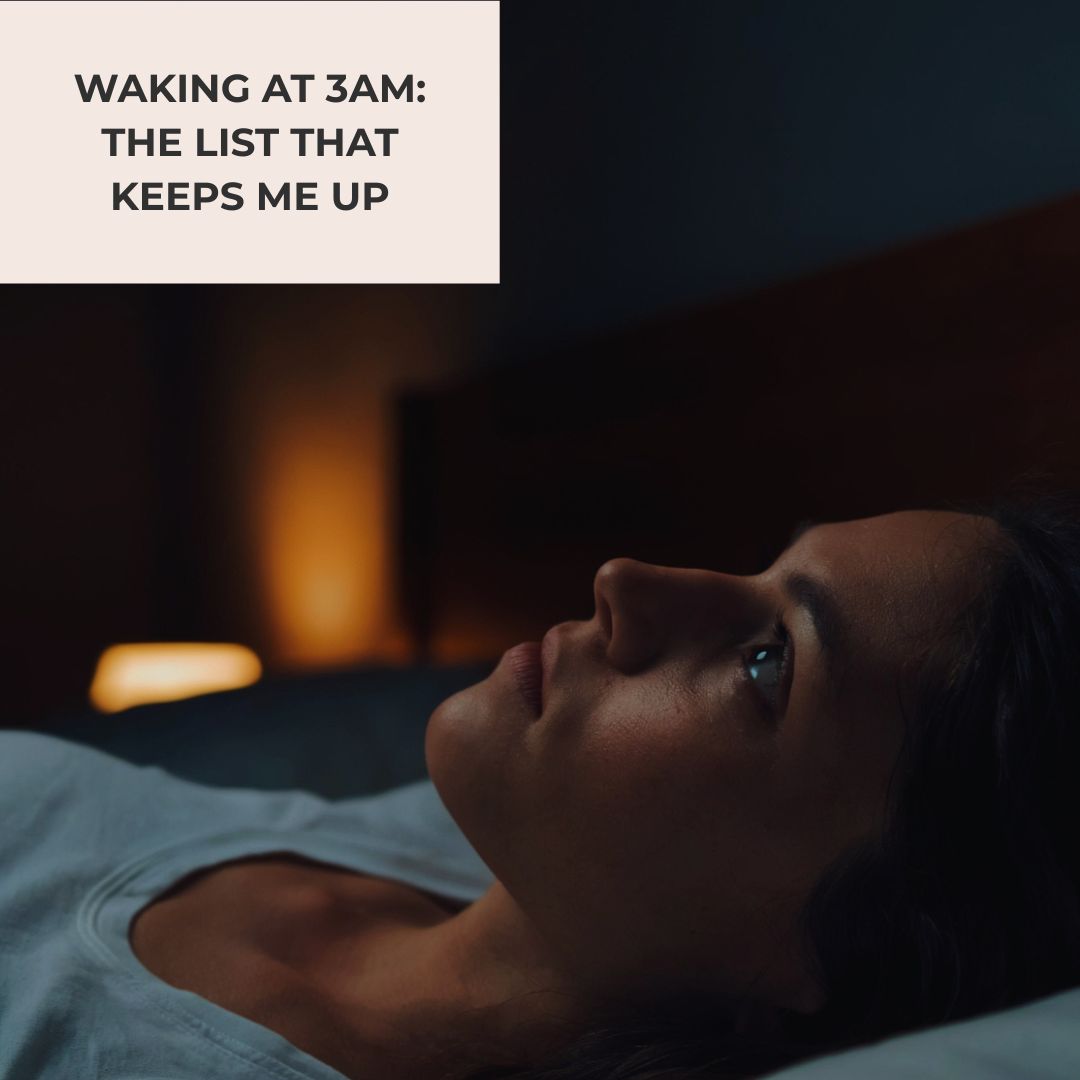
Some nights I go to bed (after falling asleep on the couch, of course), and then my eyes stay wide open.
But that’s the least of it.
It’s the constant stream of thoughts rushing into my mind (and they aren’t the good ones) that troubles me the most. A giant list of all the things that need to be done, things that need to be fixed, and, of course, the ones that have gone all wrong. The last ones usually come with disappointment in myself and regret over the most ridiculous things!
Choices I’ve made. Paths I’ve chosen. Existential things. And at the same time I might remember that I forgot to defrost the food for the next day. Or that I forgot one exercise while teaching the day before.
Deep and shallow thoughts, mixed like a soup. Not good!
Because why not do this at 3AM!
My body gets restless. I can’t find the right position to rest. I turn from one side to the other, trying to find some comfort and stillness.
And the morning after, it’s hard to get up. I feel heavier, with less energy and less desire to do things.
I’m definitely far from being the only one. As many as 46% of women have sleep difficulties in the years leading up to menopause, and about half after it (Sleep Foundation). It’s rarely one thing, either. Hormones, hot flashes, stress at work or at home, anxiety – they can all play a part (Sleep Health Foundation).
Every woman’s nights are different.
What helps me is staying consistent with my movement practice every day.
In the evenings, I force myself to stop doing things and allow myself to rest. I turn off the internet on my phone. I don’t reply to messages from work. I’m trying to get into my cocoon, where I feel disconnected from all the stimulation I receive during the day. I calm down.
If the night comes and it’s restless, I stay in bed and do a mini savasana/relaxation. No getting up, definitely no phone, just resting my body and my mind by consciously breathing.
And then sleep comes.
So if you were a student of mine asking me what to do if you can’t sleep, I’d tell you to:
- Do a mini savasana in bed. Place one hand on your chest and the other on your abdomen.
- Bring your awareness to every part of your body, from your toes to the top of your head, and let each one relax.
- Keep your exhale longer than your inhale. Breathe in for 4, and out for 6.
- Leave the phone alone. Otherwise, things will get worse!
- In the evening, build your own cocoon. Internet off, no work messages. Do things that relax you.
- And stay consistent with your movement practice every day.
And the research agrees with that. In a US trial, women aged 40 to 62 who did a 12-week yoga class and practised at home had less insomnia (MsFLASH, 2014). Mindfulness training helps sleep in the menopause transition too (Sleep Health Foundation).
I put the small things that help me into The 3AM Reset: three days of short, gentle practices for the nights you wake up and can’t get back down. It’s free, and it’s yours to keep.